Updated June 2026. Prices and features below are 2026 estimates compiled from vendor websites and published industry data — always confirm current pricing with each vendor before you buy.
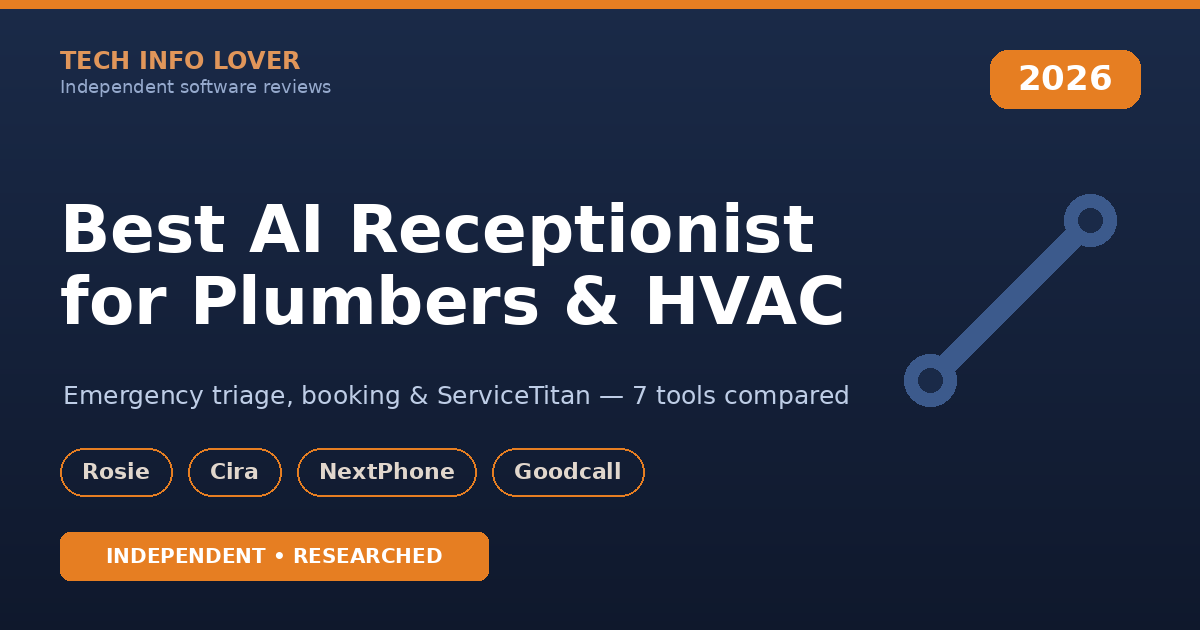
Quick answer: For most plumbing and HVAC businesses, Rosie is the best-value AI receptionist — it self-trains from your website, answers 24/7, and starts at $49/mo. If after-hours emergencies are your priority, Cira and VoiceCharm are built to detect urgent calls (burst pipe, no heat, sewage backup) and route them to your on-call tech, while NextPhone offers flat-rate unlimited answering for high-volume shops. Expect roughly $49–$300/month.
Our top picks at a glance
- Best overall value: Rosie — self-training, trades-focused, from $49/mo, no per-call meter.
- Best emergency triage: Cira / VoiceCharm — detect burst pipe, no-heat, and sewage calls and transfer to your on-call tech.
- Best flat-rate, unlimited calls: NextPhone — predictable monthly price for high call volume.
- Best for Google calls + booking: Goodcall — Google Business Profile integration, qualifies and books.
- Best hybrid AI + human: Smith.ai — AI screening with real agents for tricky calls.
- Best tight-budget pick: My AI Front Desk — low-cost 24/7 answering.
AI receptionist for plumbers & HVAC comparison (2026)
| Tool | Best for | Starting price* | Field-service integration | Emergency triage | AI + human? |
|---|---|---|---|---|---|
| Rosie | Best overall value | $49/mo ($149 for booking) | Calendar + Zapier | Transfer rules | AI only |
| Cira | Emergency-heavy home services | ~$41–$99/mo | Zapier / job tools | Yes — keyword detection | AI only |
| VoiceCharm | Urgent-call detection | Custom | Zapier | Yes — burst pipe, no-heat | AI only |
| NextPhone | Flat-rate, high volume | ~$199/mo unlimited | 100+ via Zapier | Yes — contractor-tuned | AI only |
| Goodcall | Google calls + booking | ~$59/mo | Google Business Profile | Routing rules | AI only |
| AnswerForce | ServiceTitan dispatch | ~$279/mo | ServiceTitan, Jobber native | Yes — human-scripted | Yes |
| Smith.ai | Hybrid overflow | $95/mo + per-call | 7,000+ via Zapier | Yes — via agents | Yes |
How we evaluated these tools
This guide is independent — we don’t sell an AI receptionist, and no vendor paid for placement. For a plumbing or HVAC shop, “answer the phone” isn’t enough, so we judged each tool on what a busy trades business actually needs:
- Emergency triage: can it tell a burst pipe, sewage backup, or no-heat-in-winter call from a routine quote — and get it to your on-call tech fast?
- 24/7 capture: does it answer nights and weekends, when emergency jobs (and your best margins) come in?
- Job booking & dispatch: does it book the job or push it into ServiceTitan, Housecall Pro, Jobber, or Workiz?
- Self-training: can a non-technical owner set it up from a website and Google listing in minutes?
- Honest cost: transparent pricing and no surprise per-minute overage traps.
Editor’s note: We base rankings on documented features, transparent pricing, integrations, and verified user reviews. Before you commit, call the AI yourself and describe a real emergency to hear how it triages and transfers.
Why plumbers and HVAC companies are switching to AI receptionists
In the trades, the call you miss is usually the one that pays best. A flooding basement at 11 p.m. or a furnace that quit in January is a high-value, ready-to-book job — and if your phone goes to voicemail, that customer calls the next plumber on Google. Most callers won’t leave a message; they just move on.
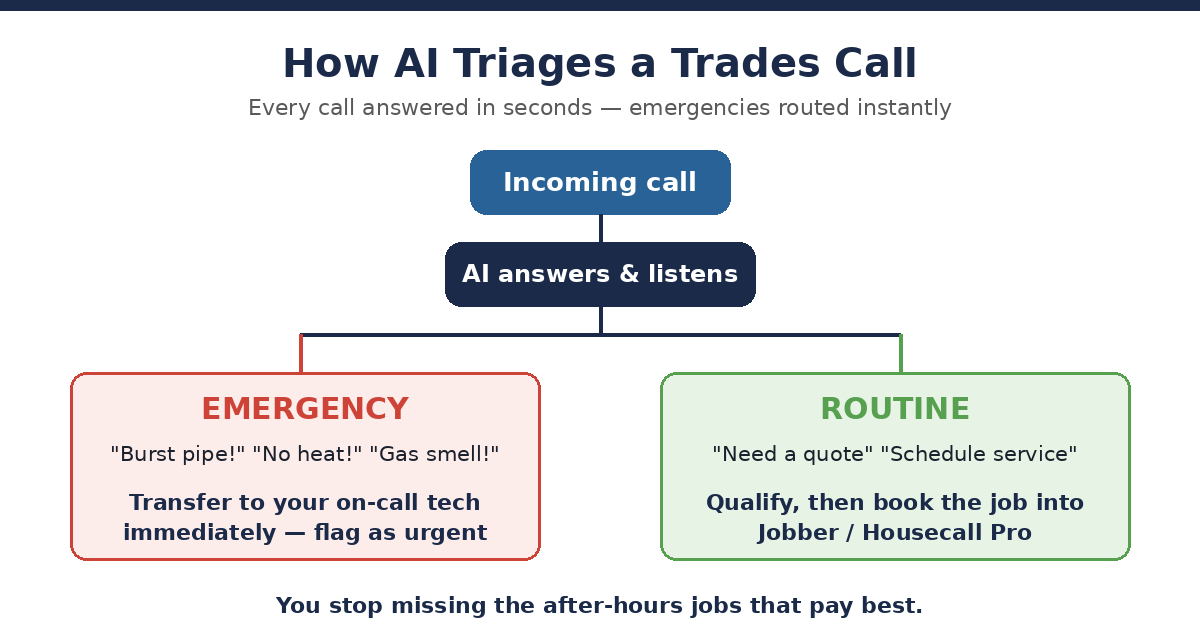
An AI receptionist answers every call in seconds, day or night, recognizes an emergency from the caller’s words, and either transfers it to your on-call tech or flags it as urgent. Routine calls get qualified and booked into your job software. You stop bleeding after-hours emergencies — without paying a dispatcher to sit by the phone.
1. Rosie — best overall value
Best for: solo and small plumbing/HVAC businesses that want the most coverage per dollar.
Rosie self-trains from your website and Google listing, answers 24/7, and starts at $49/month with no per-minute meter on entry plans. It’s popular with trades because you can be on a roof or under a sink and it still answers, qualifies the caller, and books or takes a message. Appointment booking unlocks on the $149/month plan. Set a transfer rule for emergencies and it routes urgent callers to your cell.
Strengths: self-training, lowest entry price, trades-friendly, no per-call charges.
Who it’s NOT for: shops that need native ServiceTitan dispatch or dedicated emergency-keyword AI.
2. Cira — best for emergency-heavy home services
Best for: plumbers, HVAC techs, and electricians whose calls are mostly urgent.
Cira is built specifically for home-service businesses and shines at emergency detection. When it hears keywords like “pipe burst,” “no heat,” or “sparking outlet,” it transfers the call to you or your on-call tech instead of just taking a message. If after-hours emergencies drive your revenue, Cira’s triage is the differentiator.
Strengths: emergency keyword detection, home-services focus, fast transfers.
Who it’s NOT for: businesses wanting a live human option on the same plan.
3. VoiceCharm — best urgent-call detection
Best for: emergency-first plumbing and HVAC shops.
VoiceCharm focuses on telling the difference between a true emergency — a burst pipe flooding a basement, sewage backing up, no hot water in winter — and a routine faucet swap, then prioritizing accordingly. It’s a strong specialist pick if your biggest fear is missing the 2 a.m. job that’s worth thousands.
Strengths: purpose-built urgency detection, home-services tuned.
Who it’s NOT for: owners who want the cheapest possible flat plan.
4. NextPhone — best flat-rate, unlimited calls
Best for: higher-volume contractors who want predictable costs.
NextPhone offers roughly $199/month for unlimited inbound calls — no per-minute meter — with contractor-tuned emergency routing (it knows “water heater leaking” and “no cooling” are urgent), spam filtering, calendar booking, and 100+ Zapier-bridged integrations. For a shop fielding 30+ calls a day, flat pricing beats per-call plans.
Strengths: unlimited flat rate, contractor-tuned urgency, many integrations.
Who it’s NOT for: very low-volume solos who’d pay less on a metered plan.
5. Goodcall — best for Google calls and booking
Best for: shops that get most calls from their Google Business Profile.
Goodcall has plumbing-specific positioning, integrates with your Google Business Profile, and focuses on answering inbound calls, qualifying callers, and pushing jobs toward booking. Pricing starts around $59/month. It’s a clean pick for owners who live and die by Google leads.
Strengths: Google Business Profile integration, solid qualification + booking.
Who it’s NOT for: businesses needing deep field-service dispatch.
6. AnswerForce — best for ServiceTitan dispatch
Best for: established companies running ServiceTitan or Jobber.
AnswerForce combines live receptionists with AI-assisted scripting trained on HVAC, plumbing, and electrical job intake, with emergency triage and native ServiceTitan dispatch. It costs more (around $279/month) but for a company that already runs ServiceTitan and wants jobs dispatched without lifting a finger, the integration pays off.
Strengths: native ServiceTitan/Jobber dispatch, trades-trained scripts, human agents.
Who it’s NOT for: budget-conscious solos.
7. Smith.ai — best hybrid AI + human
Best for: shops that want AI for volume and a real person for complex calls.
Smith.ai pairs AI screening with live human receptionists, starting around $95/month plus per-call pricing. The AI handles simple calls and the humans step in for complicated or high-value ones — reassuring if you worry about a bot fumbling an upset customer.
Strengths: human fallback, huge integration library, strong for overflow.
Who it’s NOT for: high-volume shops watching per-call costs.
How much does an AI receptionist for plumbers or HVAC cost?
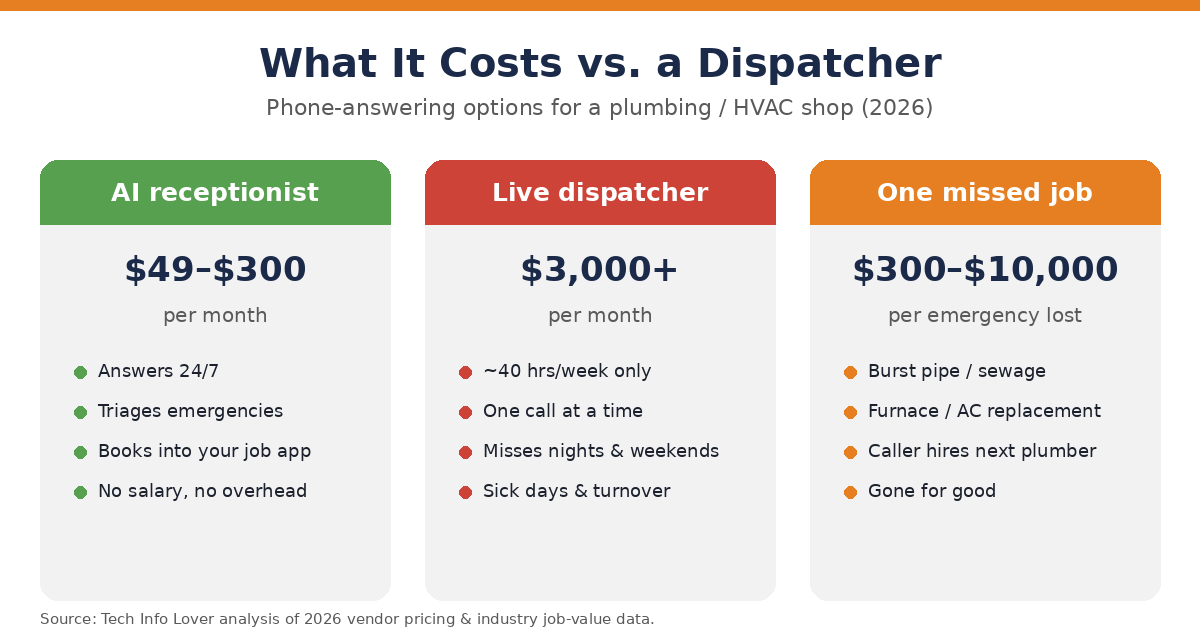
Most run $49–$300 per month: budget AI-only tools start around $49 (Rosie) to $59 (Goodcall), flat-rate unlimited lands near $199 (NextPhone), and hybrid AI-plus-human or ServiceTitan-integrated services run $95–$300+ (Smith.ai, AnswerForce). Compare that to a full-time dispatcher at $3,000+/month. Because a single after-hours emergency — a burst pipe or a furnace replacement — can be worth hundreds to thousands of dollars, capturing even one extra job a month usually covers the tool for the whole year.
Will an AI receptionist actually handle emergencies?
The good ones do. Tools like Cira, VoiceCharm, and NextPhone are trained to recognize urgent language — “pipe burst,” “flooding,” “no heat,” “no cooling,” “gas smell,” “sewage” — and immediately transfer the caller to your on-call tech or flag the job as urgent. Budget tools like Rosie and My AI Front Desk handle this with simple transfer rules you configure. Whatever you pick, test it: call in and describe a real emergency before you rely on it.
How to choose the right one for your shop
- Start with emergencies. If after-hours urgent calls drive your revenue, shortlist Cira, VoiceCharm, or NextPhone.
- Match it to your software. On ServiceTitan/Jobber/Housecall Pro? Confirm native dispatch (AnswerForce) or Zapier routing.
- Match it to your volume. Low volume → Rosie/Goodcall. High volume → NextPhone flat rate.
- Test the triage. Call in describing a burst pipe and a routine quote; judge how it handles both.
- Watch for per-minute traps. Cheap plans can get expensive with overage; flat rates are safer at volume.
Frequently asked questions
Can an AI receptionist transfer real emergencies to my on-call tech?
Yes. Trades-focused tools like Cira, VoiceCharm, and NextPhone detect urgent language such as “burst pipe,” “no heat,” or “gas smell” and transfer the caller to your on-call tech or flag the job as urgent. Budget tools handle this with transfer rules you set.
Will it book jobs into ServiceTitan, Housecall Pro, or Jobber?
Some do. AnswerForce offers native ServiceTitan and Jobber dispatch; most others connect to Housecall Pro, Jobber, and Workiz through Zapier. Confirm your specific software is supported before you sign up.
How fast can a plumbing or HVAC business set one up?
Self-training tools like Rosie can be answering calls in well under an hour — you forward your number and it learns your business from your website. Software-integrated services take longer to connect to ServiceTitan or Jobber.
Is an AI receptionist worth it for a small plumbing or HVAC business?
For most, yes. If it captures even one extra after-hours emergency a month — often worth hundreds to thousands of dollars — a $49–$199 tool pays for itself many times over.
The verdict
For most plumbing and HVAC businesses, Rosie is the best-value AI receptionist — cheap, self-training, and trades-friendly. If after-hours emergencies are your lifeblood, choose a triage specialist like Cira or VoiceCharm; if you field high volume, NextPhone’s flat unlimited rate is hard to beat; and if you want a human safety net, Smith.ai delivers. Whatever you pick, call it with a fake burst-pipe emergency before you trust it with real ones.
Related: AI Receptionists for Small Business (complete guide) · AI Receptionist Cost in 2026 · 7 Best AI Receptionists for Small Business